The Minimum Sellable Unit
In late August 2026, Amazon announced the end of Mechanical Turk. The shutdown date: September 30.
Jeff Bezos presented it at MIT in 2006 with a name that said everything: human-as-a-service, a cloud API where the computation was people. Twenty years later, the marketplace that named a category is dying in the same season the category conquers the economy. It was killed by the force it predicted. Intelligence became cheaper than the humans simulating it.
The mirror image launched the same year. RentAHuman is a marketplace where the customers are AI agents and the workers are people, hired for what machines still cannot do: hands, presence, a signature.
Twenty years ago, humans were paid to pretend to be software. Now software pays humans to be human.
This essay is about what that force does to the oldest business in the world: selling judgment.
Three prices nobody questions
A formal legal opinion from a top firm costs $50,000 to $500,000. A private doctor's visit costs a few hundred dollars, an appointment, and a waiting room. A serious course costs a thousand.
Meanwhile, the advice people actually need on a normal Tuesday has no price at all. What the chef you follow would cook with the chicken in your fridge. What a veteran mother of four does at 3am with a feverish baby. Whether the job in the other city is worth moving your family for. Everyone wants that judgment. Nobody has ever been able to buy it.
And some judgment money never bought at all. Think of a chaired professor at her country's best law school. Her thinking was never for sale at any price: to hear it every week, you had to win a seat in her classroom, and to win the seat you had to pass one of the most competitive admission exams in Latin America at eighteen, which required the family structure, the schooling and the luck that prepare a teenager for that exam. The unit was a life.
These numbers feel like facts of nature. They are package sizes, and the missing prices are missing packages.
Every service has a minimum sellable unit: the smallest slice of it you can actually buy. For legal judgment, the unit has been the opinion or the hour. For medical judgment, the consultation. For the judgment of a great professor, the unit was admission. For everyday wisdom, there was never a unit at all: it lived in the gift economy of family, friends and comment sections, rationed by who you knew. Below the unit, a market simply does not exist. You cannot buy four dollars of a great lawyer, or ninety seconds of a great chef. Until now, nobody could sell them to you.
We searched for the name of this concept across five literatures: strategy, law, pricing, labor economics, the sociology of professions. The fragmentation process has many names (unbundling, decomposition, productization). The unit itself has none. Economists measured everything and never named the smallest thing you can buy from another human mind.
So name it, and then watch it collapse. The minimum sellable unit of human judgment is currently falling by four to seven orders of magnitude. Almost every consequence of the AI era's consumer economy flows from that single collapse.
Where unit sizes come from
Unit sizes look natural. They are manufactured, by four forces.
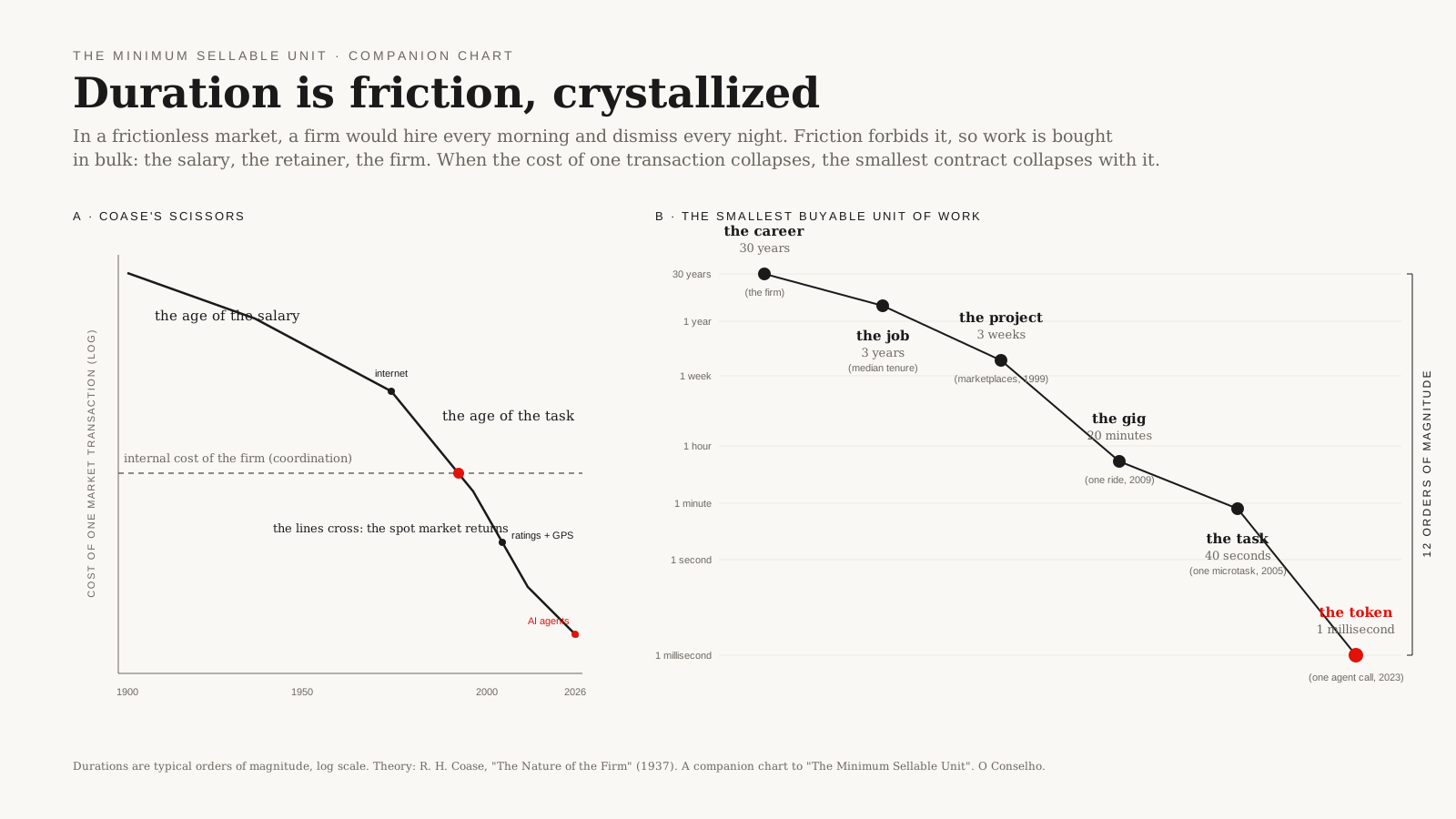
Transaction costs. Every purchase carries overhead: finding, scheduling, negotiating, trusting. Coase built a theory of the firm on this in 1937, and an old fantasy from economics makes it visible: in a frictionless market, a company would hire its whole workforce every morning and dismiss it every night, buying labor by the day the way it buys electricity by the hour. Friction forbids the daily bargain, so the market invented the permanent one. The salary is a wholesale purchase of future work. The firm is a bundle of long contracts that exists to save everyone from ten thousand small negotiations. The rule reaches every service: where transacting is expensive, contracts grow long and packages grow large. The one-hour consultation exists because commuting and small talk do not pay for themselves in six minutes. Duration is friction, crystallized.
The rival body. Paul Romer's growth theory (1990) contains the sharpest sentence in this whole story. A design, once created, can serve everyone at once. A skill cannot, because it lives in a body: the expert cannot be in two places at the same time, training a second expert costs as much as training the first, and the skill dies with its owner. The knowledge of a great advisor was always non-rival. The delivery vehicle, her attention, was rival. We sold the vehicle because we could not ship the cargo by itself.
Cost disease. Baumol observed that a string quartet takes the same four musicians it took in Mozart's time, while their wages must follow the rest of the economy. Services made of human attention therefore get relatively more expensive every decade, by arithmetic. David Autor measured the result: relative to household income, US healthcare rose about 200 percent and higher education roughly 600 percent over four decades, in sectors he describes as guild monopolies of highly educated experts.
Guild law. The billable hour is younger than the airplane. A legal-aid lawyer imported time tracking into law practice in 1913 as an internal management tool. A 1958 American Bar Association pamphlet turned it into the billing method. A 1975 Supreme Court antitrust ruling killed the old per-task fee schedules and made the hour universal. Medicine went the opposite way: since 1992 every medical act in the US carries a relative value unit for billing, while access stayed locked at one consultation. The therapy session lasts 50 minutes because of a scheduling convention in Freud's consulting room.
None of these forces is the customer's need. So when the forces move, the unit moves, and the old prices stop looking like nature.
What happens when the unit collapses
It has happened before. It ends the same way every time, in three acts.
Act one: latent demand detonates. In January 1840, Britain replaced distance-based postage (fourpence and up, paid by the receiver) with the Uniform Penny Post: one penny, prepaid, anywhere in the kingdom. Letters more than doubled in the first year and doubled again within a decade. Those letters had never been written at all. The same hidden mass exists in advice. The US Legal Services Corporation found that low-income Americans receive inadequate or no help for 92 percent of their civil legal problems. Nobody counts the questions that were never asked. That silence is the largest market in advice.
And the appetite is proven. Dear Abby, a column of everyday advice about love, family and manners, reached over a hundred million readers across more than a thousand newspapers, at a unit price of zero, funded by ads. When someone finally priced personal counsel by the minute (the Miss Cleo psychic hotline, at $4.99 a minute), a single company billed customers an estimated billion dollars before the FTC closed it in 2002. Demand for fragmented advice was never in doubt. Governance was.
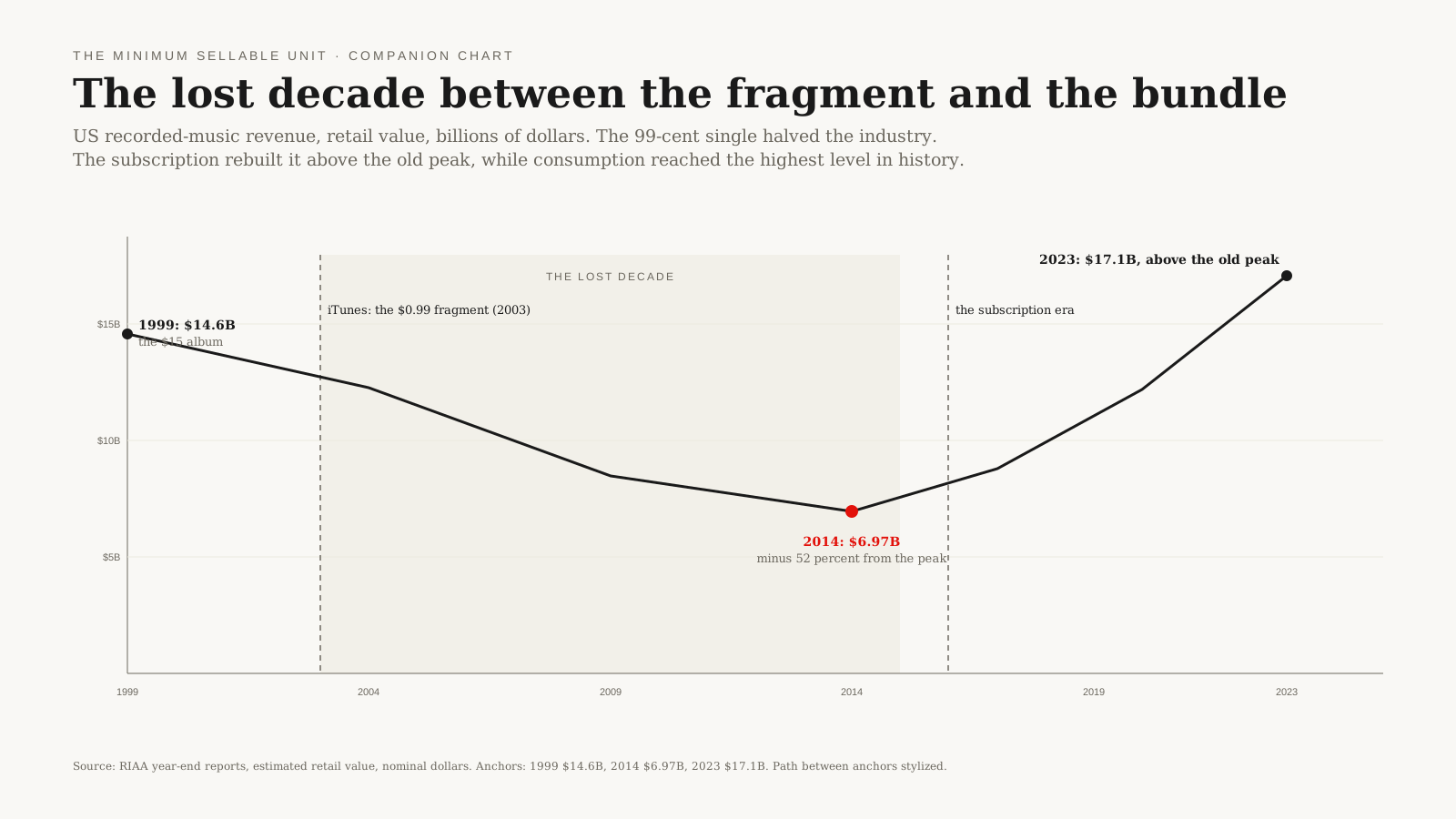
Act two: whoever sells the fragment loses to whoever re-bundles it. Recorded music fragmented from the $15 album to the $0.99 iTunes single in 2003, and US revenue fell by half, from $14.6 billion in 1999 to below $7 billion in 2014. Then subscription re-aggregated the fragments, and the global industry has since grown eleven straight years to record highs, with consumption the highest in human history. Spotify will not even quote a per-stream price anymore. The lesson generalizes, and economics explained it in advance: with near-zero marginal cost, the big bundle beats à la carte (Bakos and Brynjolfsson, 1999). Micropayments die of decision fatigue (Szabo's mental transaction costs). Consumers happily pay extra for flat rates just to avoid a running meter (the taximeter effect). So the unit shrinks as a metric, never as a shopping experience. Fragment the pricing. Hide the meter. Sell the pool.
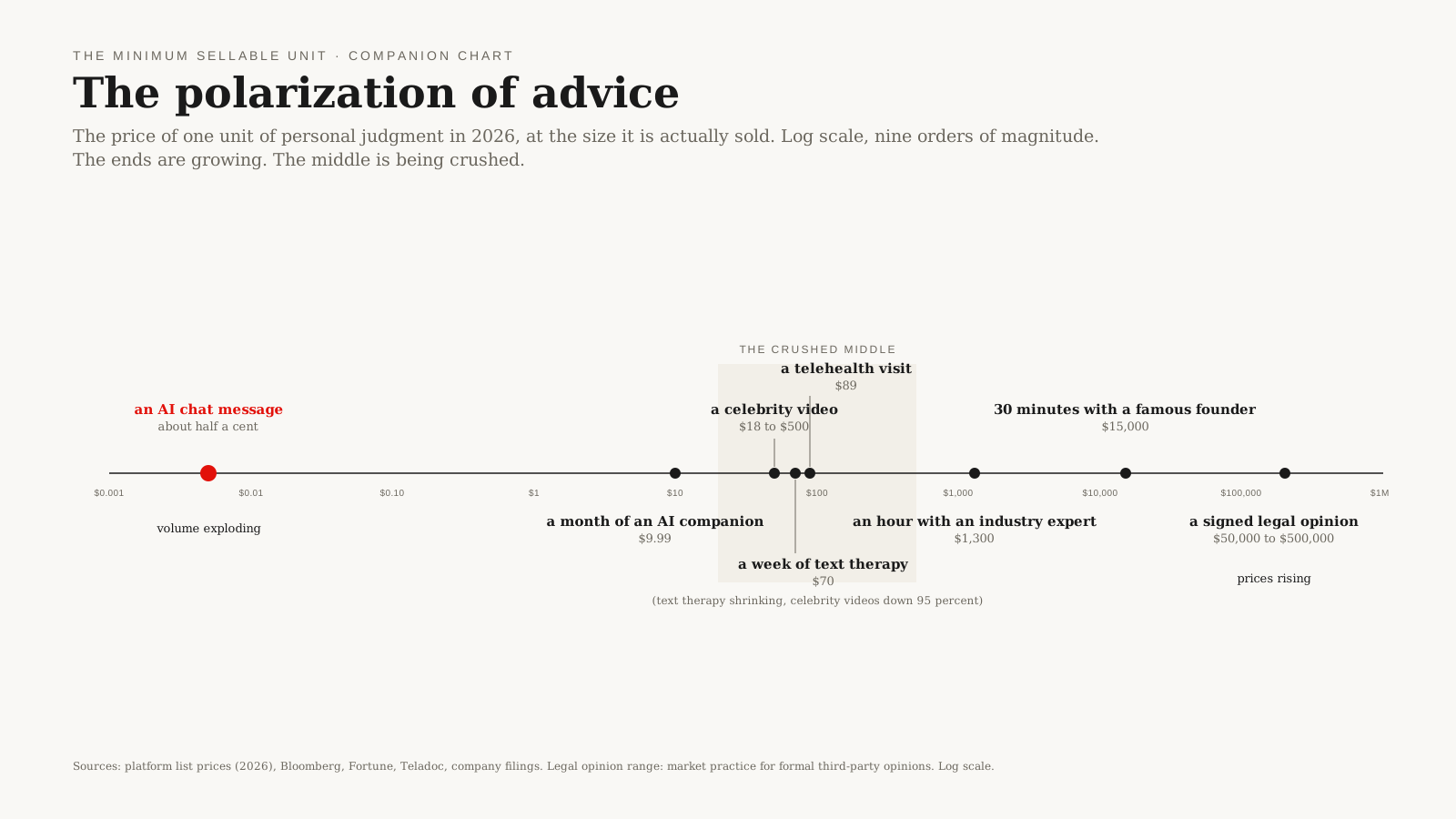
Act three: the top of the market gets more expensive. Walter Benjamin saw it in 1936: mechanical reproduction spreads the work everywhere, while the aura retreats into the original, and the original gains value. It is measurable today. While AI answers fall toward cents, expert-network phone calls run $1,000 to $1,400 an hour, and that category just consolidated in a $930 million acquisition. Nikita Bier, a former X product chief, charges founders $15,000 for thirty minutes. ABBA Voyage, a frozen, dated, licensed replica of a band that last performed in 1982, generated over £200 million in its first two years in London. Cheap copies do not kill the original. They advertise it.
Fragmentation, in other words, polarizes the market. The middle (the generic consultation, the generic course) gets crushed. The fragment scales to everyone. The original, live and accountable, becomes luxury. Labor economists found the same shape in jobs and named it polarization.
This is also the oldest pattern we found. At the Delphi of antiquity, the oracle spoke one day a month, and cities that funded the sanctuary bought promanteia, the right to skip the line. Beside the expensive oracle ran a cheap one: yes-or-no questions, answered by drawing colored beans. Priority access and a fractional product, twenty-four centuries ago. In the Middle Ages, law professors sold individual opinions called consilia, and publishers later printed them into volumes any lawyer could cite: the single counsel became a reproducible product in 1547. The unit has been trying to shrink forever. It was waiting for the marginal cost of judgment to fall.
The price of intelligence collapsed
In March 2023, GPT-4 cost $30 per million input tokens. Sixteen months later, GPT-4o mini cost 15 cents. That is a 200x drop. Andreessen Horowitz measured GPT-3-class intelligence falling 1,000x in three years. Sam Altman wrote in 2025 that "intelligence too cheap to meter is well within grasp."
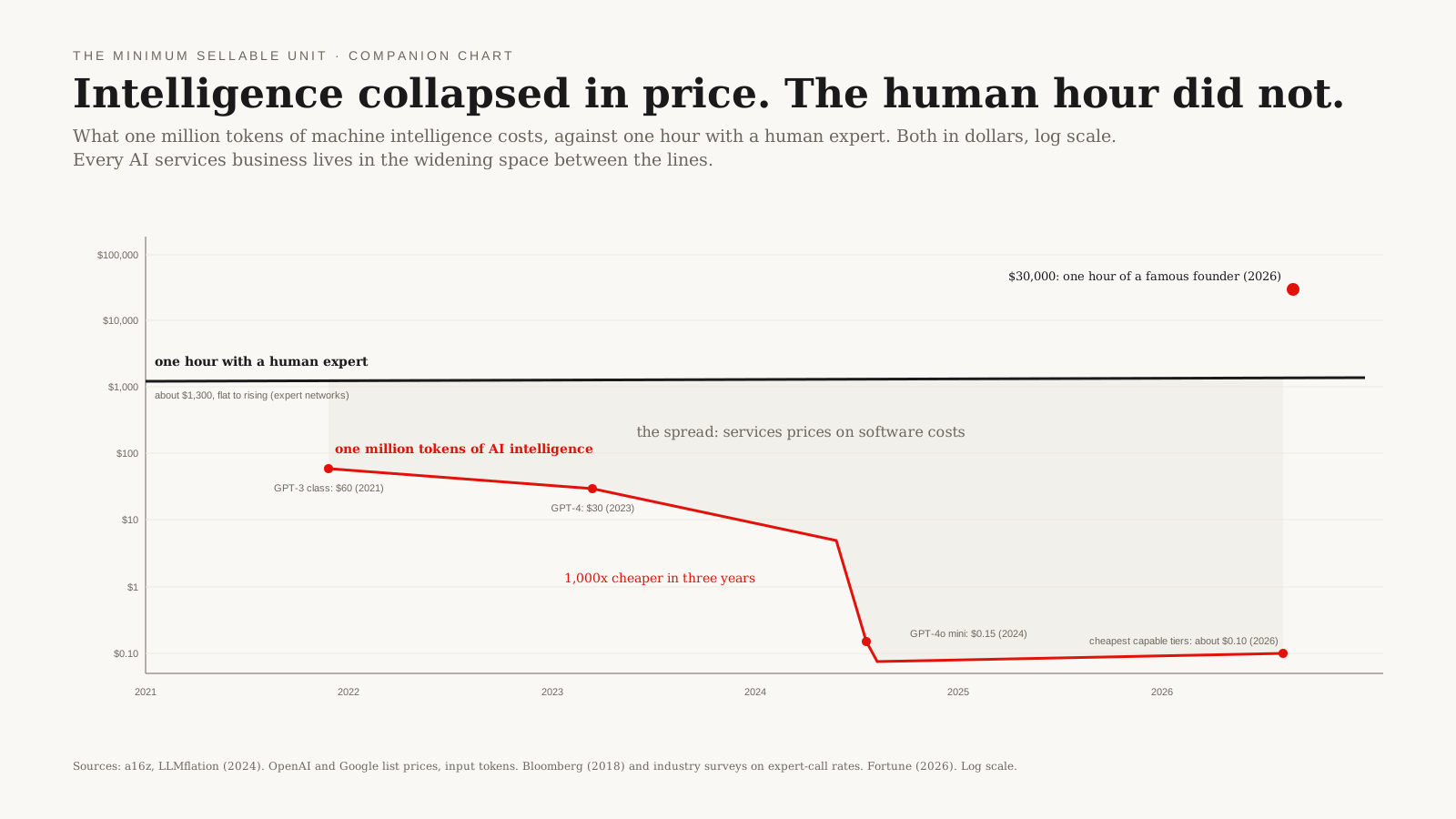
Venture capital has noticed what this does to services. Sequoia's number this year: six dollars flow to services for every dollar that flows to software, so stop selling the tool and sell the work. Foundation Capital measures the same idea at $4.6 trillion in wages against a $200 billion SaaS market. The multiples differ by methodology. The direction is consensus: the next giant software companies will look like service firms.
Now look at the opportunity maps these firms publish. Insurance brokerage. Accounting. Medical billing. Claims. Tax. IT. Procurement. Every vertical is B2B, because the playbook says to start where an outsourcing budget already exists, so that the sale is a clean vendor swap.
Advice to a person has no budget line. There is nothing to swap. A human being with a hard decision at 2am has never had a procurement category. That is precisely why the biggest consumer opportunity of the AI era is invisible on every one of these maps. There are two species of AI services company. One keeps the unit and swaps the producer: it sells the closed books or the drafted contract to the same buyer at a similar price. The other shrinks the unit by orders of magnitude and sells to the billions who never bought at all. The first species fights over existing invoices. The second creates invoices where none existed. That is what the Penny Post did. Every measured TAM misses it by definition.
The sequence matters. Google commoditized information: the facts became free. AI is commoditizing intelligence: the reasoning is becoming free. Each wave pushes the value up one layer, to whatever it cannot copy. So the question is simple. What is left?
What refuses to fragment
Honesty requires this section. A professional consultation was never one product. It bundled five things: the value (confidence to decide), the delivery (the hour), the metric (time), the billing (the invoice), and the liability (a licensed human who signs and answers for the advice).
Four of those fragment beautifully. The fifth does not fragment at all.
Philosophy is precise about why. A signed opinion is, in speech-act terms, a verdict: an institution stands behind it, legal reliance attaches to it, malpractice insurance prices it. A chat answer, however brilliant, carries information. The signature carries transferred responsibility. That distinction is why the $500,000 opinion survives the five-cent question, and even benefits from it: every fragment of advice in circulation advertises the moment when you will need someone accountable.
Something else refuses to fragment: a specific person's judgment. Generic intelligence is a commodity in free fall, identical from every provider. The taste, the instincts and the accumulated pattern recognition of a particular human being are the one input the model companies do not own. There is a difference between believing something and believing someone. What you want from a person you trust is their word, attached to their name. The contest of the next decade follows directly. Everyone will run the same models. Very few will hold exclusive, well-governed rights to the minds people already trust.
There is a deep reason judgment resisted. Rules can be taught. Judgment, the ability to apply the rule to the case in front of you, cannot: teaching it would take a rule for applying rules, forever. And we all know more than we can say. That is why information commoditized and judgment did not, and why distilling a person took until now: models finally learn dispositions, and dispositions were never written down. Trust, in turn, has a precise job: it is permission to stop deliberating. Google gives you ten million results. The person you trust gives you the end of the search. The cheaper information becomes, the more that ending is worth.
From tools to places
There is a final turn, and it decides who wins.
A one-on-one AI chat is a tool. Its value per user is flat, its conversations are silos, and its churn problem is already visible in the subscription-therapy market. Economics has a name for what it lacks. Sherwin Rosen showed in 1981 that superstar economics requires joint consumption: one performance serving many people at once. Radio had it. Records had it. A private chat does not.
A room has it. Think of the old IRC channels, or of the WhatsApp groups that run daily life across half the world: many people, several minds, one conversation. A single deliberation among digital minds, read by a whole room, amortizes its cost across every listener. China's Fenda proved the mechanics in 2016 by charging one yuan to eavesdrop on someone else's paid answer, and every radio call-in show proved it decades before. Rooms also cure the founding disease of each industry. Social products die of empty rooms. AI products die of shallow one-on-one churn. A room whose resident minds never sleep is never empty. A room full of humans gives those minds a public, a common agenda, and a reason to return.
Tools earn subscriptions. Places earn network effects. The trillion-dollar consumer companies of the last era were all places.
The staff follows the council
Everything above applies to a second category of work: execution, on top of advice. The butler was sold in the largest unit of all, a salary. So were the private banker, the property scout, the personal shopper, the secretary. Help was priced in payrolls, so it belonged to the same castles as the counsel. AI fragments the servant the way it fragments the sage. The supermarket order, the apartment search, the audit of your bills, the watch over your calendar: each becomes a task you can finally buy one at a time. And the fifth unit holds here as well. The agent prepares the tray, and the person gives the final yes. The click, the signed order, the payment, the consent: those stay human, by design and by law. Counsel too big to buy and help too big to hire were the two halves of the same locked door. One collapse opens both.
What we are building
I run O Conselho ("The Council"), and we are building this thesis from Brazil.
Begin with what the counsel actually is, because very little of it resembles a legal opinion. It is the famous chef deciding your Tuesday dinner with you. It is the mother trusted by a million parents guiding you through your child's fever at 3am, in her voice, with her patience. It is the professor whose classroom existed behind an exam you never took. It is the coach, the pastor, the nutritionist, the investor you already trusted from a distance, now answering you in particular. That layer of judgment was never professional and never for sale. It is the largest part of the latent market, and the part that needs no license, no signature and no waiting room.
The product is the table: licensed digital versions of real experts and creators, each one exclusive, governed by a canon the person approves, with the human as economic partner in their own digital self. They deliberate for ordinary people, in chat and in rooms. Around the table, household agents turn the decisions into tasks, up to a final yes that always belongs to the person. And the live human layer stays deliberately scarce and expensive at the top of the ladder. The product is live in Brazil today. The first nine deals are closed: minds that together reach almost thirty million people, with another eighty creators in the pipeline. The anchors also triggered something we expected, but not this fast: niche professionals, the sports doctor, the tax lawyer, the performance nutritionist, have started to come to us, because in a market of superstars every niche will have room for only a few digital minds, and nobody wants to watch a colleague become the mind of their specialty.
Each of these minds is a durable intellectual property asset: licensed, governed, and generating cash flow of its own, independent of the person's calendar. David Bowie showed in 1997 that the catalog of one person can be an asset class, when he sold $55 million in bonds backed by his royalties. A distilled mind is the next catalog.
Why Brazil first: it is the only large economy with free, instant, universal micropayment rails. Pix moved more than 20 trillion reais (over 3.5 trillion dollars) in the first seven months of 2026, and recurring Pix payments launched in 2025. And Brazilians have been socialized in mixed rooms for 25 years, from Orkut communities to the WhatsApp groups that organize everything. The infrastructure for selling judgment by the token already exists here.
The minimum sellable unit of counsel has collapsed. What we do with the fragments is the rest of the story: we re-aggregate them around the buyer. For most of history, a council was what kings and presidents had, a table of minds arguing over one person's problem, with a staff to execute the answer. That is the package we sell now, by the month, for the price of a pizza.